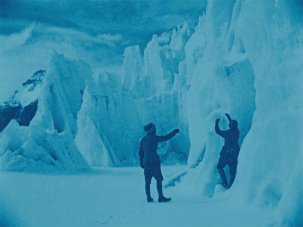
81: CLOSE ENCOUNTERS OF THE THIRD KIND

Still: CLOSE ENCOUNTERS OF THE THIRD KIND

All images are the copyright of their respective rightsholder and may not be reproduced from this site without permission of the rightsholder.

USA 1978 Dir Steven SPIELBERG

(Year refers to British release)

Running Time: 135 minutes
Colour: Metrocolor

Estimated Attendance: 8.54 million

View cast and credits

What they said at the time...

Synopsis

When a massive power blackout hits large areas of Indiana, workman Roy Neary is sent out to investigate and is flabbergasted when his truck is suddenly caught in a cone of intense light and shaken by tremors. He follows what appear to be strange craft in the sky, and on the way encounters other people similarly affected, including Jillian Guiler, whose small son Barry ran from the house in delighted pursuit of these uncanny presences. Meanwhile, Claude Lacombe, an international researcher into UFO phenomena, has discovered that the craft may be transmitting a musical signal, which translates mathematically into the map co-ordinates of a site in Wyoming. Having already been fired from his job, Roy's increasingly strange behaviour since his experience, particularly his obsession with sculpting models of a mountain, upsets his wife Ronnie and their children. They finally leave when he begins constructing a giant model in the living room, but Roy at last realises (as does Jillian Guiler, who has had similar visions and lost her son to the alien presences) that the real mountain is the Devil's Tower in Wyoming, where Lacombe and his team have created a nerve-gas scare to clear the area. In an effort to reach the Tower, Roy and Jillian are caught by troops (along with others drawn by the same vision) but escape to cross the mountain and find the secret landing site prepared by Lacombe and his men for the aliens. The latter finally arrive, and after an exchange of musical messages, release the humans (including Barry) they have 'borrowed' at different times for study; a team of scientists (now including Roy) leave on a mission with the obviously benevolent extraterrestrials.

Review

Before it succumbs in the second half to a tone of awed, quasi-religious uplift (efficiently packaged as the 'Force' in Star Wars), and to a plot borrowed from the most complacent science fiction of the Fifties, Close Encounters of the Third Kind is a startlingly innovative blockbuster. Tone, as it happens, is all important, for in no real sense does the film have a theme - or rather its theme is its plot mechanism, the means by which Everyman, power-worker Roy Neary, is sucked into a transcendental experience, swept from a middle-America of soap operas, pink flamingos and domestic chaos into the ecstatic realm of a sweaty, mud-splattered seer, struggling to realise his vision in a mountain of dirt and rubble piled on the electric train setting in his living room. The mechanism is the same which draws audiences into the film, inviting them to become Everyman - though they are really offered a double identification figure, with Neary as the ordinary mortal who is suddenly seized with the intensity of Van Gogh and Claude Lacombe as the scientist/intellectual also invested (Francois Truffaut effortlessly incarnating an old archetype) with a generous dose of Gallic humanity. So what the film is 'about', in a way, is its own illusionism, the process by which it creates a world we are invited to share - an approach intimated, after all, by Jaws, whose three men in a boat were our representatives going up against the terror of the unknown. And it has been a constant characteristic of Spielberg, from Duel onwards, that the details of plot, character and setting have a peculiarly blank, unmediated quality - all phenomena are not only equal in his world but self-sufficient and self-explanatory (which may also have something to do with the powerful but unexpressed 'movie' consciousness behind his work - the real world only exists as a pretext for the director). Hence there is no discussion here - or analysis at any level - of the UFO phenomenon as such: the bright lights and funny craft that come whipping out of the sky exist only as triggers - first for the film-maker Spielberg, then for the artist/seer Neary and investigator Lacombe, and finally for the sense of wonder in the audience. In this way, the film adroitly sidesteps the need to suggest possible explanations — mass hysteria, sinister military experiments - and never allows the audience's scepticism to gain a foothold. Having cleared (or bypassed) the rational ground, Spielberg is free to concentrate on the magic - the gift of both movie-makers and extraterrestrial super-beings. And at this level, the film is a joy to watch, anchoring its unimaginable events in the most ordinary settings imaginable, producing a peculiar frisson that is part poetic, part comic. In one of the earliest manifestations of the aliens' presence, a child wakes at night to find all his mechanical toys coming to life and scuttling about the floor (even so simple an identification has a fairly complex reflexive function: a childish innocence distinguishes those, such as Neary, first seen playing with an electric train, who will be touched by the aliens' message, but the aliens are also, of course, simply the toys of the special effects department). Running outside after his night-visitors, the boy is spotted by his bleary-eyed mother giggling on the lawn in a pale circle of light - an exquisite shot, capped by a later moment when the child rounds a bend on a lonely country road, now palely lit by the moon, to confront a silent, stolid group of farmers also waiting for the lights to reappear ("They can fly rings round the moon", one of them grudgingly admits, after the aliens have obliged, "but we're years ahead of them on the highway"). Neary's excited attempts to tell his wife about the extraterrestrials prompts some puzzled discussion as to whether their craft are shaped more like ice-cream cones or some variety of Sara Lee cookie, and Spielberg brilliantly intertwines both the pathos and bathos of this working-class family man's plight during a dinner-table scene, when Neary begins obsessively shaping a heap of mashed potato into the mountain of his dreams, then realising that his family is watching him in tearful dismay, offers the reassurance, "I guess you've noticed something a little strange with Dad. It's okay, though. I'm still Dad". In his first scene, Neary's visionary role is anticipated by the sight of The Ten Commandments flickering on a television; later, when he wakes to the realisation that he must turn his whole house into a receptacle for his vision. Daffy Duck is duelling on the small screen with a Martian, and the subsequent scene, of Neary frantically filling his house with materials for his mountain, is properly cartoon-like in its manic action and cacophony of bangs and crashes. As the power on earth which shares the aliens' ability to implant images in the minds of millions, it is fittingly television which finally draws Neary and his fellow visionaries to the Devil's Tower. But it is also about here that the plot begins to go into overdrive, with the Hitchcockian flavour of some of Spielberg's tricks of audience control coyly emphasised by the Herrmann-esque tones of John Williams' score and an over-extended Rushmore-type chase sequence on the Tower. And even the feverish anticipation which the film has worked up for the orgy of special effects that will attend its close encounter of the third kind is undercut by the final miscalculation of actually showing the aliens, and by the blanket of awe-struck goodwill which it draws over the doings of not only the creatures from space but the powers-that-be on earth. For all its hesitations and insufficiencies, however, Close Encounters of the Third Kind is the first of the new breed of science fiction film which approaches the best in the literature, and effectively obliterates the faint, sterile traces of Star Wars.

Synopsis and Review from Monthly Film Bulletin.Vol.45.No.531 April 1978 p.63-64

The Monthly Film Bulletin was published by the BFI between 1934 and 1991. Initially aimed at distributors and exhibitors as well as filmgoers, it carried reviews and details of all UK film releases. In 1991, the Bulletin was incoporated into Sight and Sound magazine.

Last Updated: 12 Jun 2009