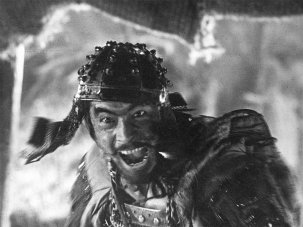
54: A CLOCKWORK ORANGE

Still: A CLOCKWORK ORANGE

All images are the copyright of their respective rightsholder and may not be reproduced from this site without permission of the rightsholder.

Great Britain 1972 Dir Stanley KUBRICK

(Year refers to British release)

Running Time: 136 minutes
Colour

Estimated Attendance: 9.9 million

View cast and credits

What they said at the time...

Synopsis

England, the near future. Stimulated by their nightly beverage of milk-plus, Alex DeLarge and his three teenage 'droogs', Dim, Pete and Georgie, spend a typically enjoyable evening beating up a drunken tramp, demolishing the members of Billyboy's rival gang, and causing several accidents with their stolen car before invading and wrecking an isolated homestead whose owner, Mr. Alexander, watches in an apoplectic rage as they take turns at raping his wife. Next day, while his parents are at work, Alex receives a cautionary visit from social worker Deltoid and enjoys an orgy with two girls he has picked up in a record store before setting out for another evening of violence. After slashing Dim across the hand to reassert his leadership, he heads a plundering expedition to a luxurious health farm whose suspicious owner, the Cat Lady, alerts the police seconds before Alex breaks in and kills her. Abandoned by his gang, Alex is arrested and receives a fourteen-year prison sentence for murder. After two years, he makes a bid for freedom by volunteering to undergo the experimental shock treatment which the Minister of the Interior is advocating in a vote-getting attempt to eliminate crime (and, incidentally, to empty the cells for political prisoners). Under the supervision of Dr. Brodsky, Alex is duly brainwashed; after two weeks he is released into society, incapable of countenancing sex and violence or of listening to his beloved Beethoven's Ninth without being assailed by nausea and a terror of death. His nervous parents greet him with the news that their new lodger has taken his place, and a homeless Alex wanders along the Embankment, where he is recognised by a former victim and set upon by a gang of tramps. He is rescued by two policemen — Dim and Georgie, who have found their place in society; knowing him to be defenceless, they beat him to a pulp and abandon him in the countryside. Alex staggers to the nearest house; its owner, Mr. Alexander, paralysed since Alex's assault and crazed by the subsequent death of his wife, decides to combine his personal revenge with a scheme to discredit the Government, and drives Alex to attempt suicide by his repeated playing of Beethoven's Ninth. Slowly recovering in hospital, Alex accepts a lucrative offer from the Minister, anxious to demonstrate to the press and public that he has done the boy no lasting harm. Alex lies contentedly in his hospital bed, dreaming of rape to the stirring strains of Ludwig Van.

Review

From Paths of Glory to Lolita, Dr. Strangelove and 2001, Stanley Kubrick has shown himself an intrepid explorer of closed universes. The no-exit situations through which he rotates his characters result from so finely dovetailed a relationship between psychological obsession and social mechanism, that it is impossible to determine whether his characters' minds are intended as metaphors for society's prison or their external universe as a magnifying glass held up to the barren confines of the human soul. Macro - and microcosm become interchangeable in Kubrick's coherent cosmos. A sardonic moralist, he charts the closing — in the name of progress — of the fields of moral choice; and his hermetic worlds breed the heroes they deserve. If A Clockwork Orange emerges as his most cynical and disturbing film to date, this is less because — as was already the case in Dr. Strangelove — the nightmare future which it predicates a recognisable extension of the present day, than because it so devastatingly and totally reduces its audience to the level of its characters, all of them perfectly adapted to the cynical system which contains them: the prison chaplain protests that the 'reformed' Alex “ceases to be capable of moral choice” moments after he has bludgeoned his captive parish into some spirited hymn-singing; while through their provocative clothing and the artistic pornography that clutters their homes, Alex's victims reveal that their imaginative horizons are bounded by the fantasies of sex and violence which he alone has the courage to indulge without recourse to the Jesuitical intermediaries of art or politics. At the stage where he is "being very interested in the Big Book", Alex has visions of himself as a Roman torturer whipping Christ on to Calvary; yet it is rather in the light of a Christ-like martyr that Kubrick compels us to observe his crucifixion and subsequent resurrection at the hands of his society. The opening shot of Alex with his false eyelashes, bowler hat and inflated cod-piece seemingly establishes him as an alien and antipathetic being; yet as he moves round the inexorable treadmill of his destiny, our sympathies imperceptibly shift; and the comic-strip caricatures through which Kubrick moves him transform Alex from thug to victim to the vicarious agent of our own carefully induced anarchy. If we are shocked by Alex's violation of bourgeois property (women included), it is only on an intellectual level, since Kubrick carefully distances his effects, postponing our physical discomfort for the moment when the 'therapists' screw their clamps on to Alex's eyes; by the time Alex regains consciousness in his hospital bed, Kubrick has us rooting for him to resume his thuggery - the only way left to us or him of saying ‘no' to this dehumanised society. For Kubrick controls his audience with the same calculated precision that he imposes on his material, obliging us to shed our humanity that Alex may acquire it. He achieves this complicity, not merely through Alex's confidential monologues with their conspiratorial initiations into his secret language, but through an impeccable balancing of the fantastic and the real that flatters every paranoiac nightmare. He moves his gaudily painted cardboard characters through real locations, and choreographs their vicious acts to a finely chiselled score of popular classics that gives them the inevitability and even the grace of a familiar ballet. The film's dynamic movement is punctuated by arresting tableaux which seem only a short nightmare away from reality, like that of the Cat Lady fighting off her assailant with a bust of Beethoven as he smashes at her with a giant china phallus. As Malcolm McDowelI's superlative Alex observes, "It's funny how the colours of the real world only seem real when you viddy them on a film". In Kubrick's film, they seem even more real than in Anthony Burgess' novel, since so many of the things which Burgess prophesied (the thugs enlisting in the police force) have already come to pass.

Synopsis and Review from Monthly Film Bulletin Vol.39 No.457 February 1972 p.28-29

The Monthly Film Bulletin was published by the BFI between 1934 and 1991. Initially aimed at distributors and exhibitors as well as filmgoers, it carried reviews and details of all UK film releases. In 1991, the Bulletin was incoporated into Sight and Sound magazine.

Last Updated: 12 Jun 2009